Aircraft parts documentation, traceability, and condition explained

Aircraft Parts Documentation, Traceability, and Condition Explained

Aircraft parts are not defined by part numbers alone. In practice, the usability, acceptance, and value of an aircraft component are determined by its documentation, traceability, and condition, and by how these elements align with regulatory and operational reality. Understanding this relationship is essential for operators, CAMOs, MROs, and asset owners.

In the aviation aftermarket, documentation is often discussed as a checklist item. In practice, documentation is the foundation that determines whether a part can be installed, repaired, sold, or even economically evaluated. A physically sound component without acceptable documentation may have limited or no operational value.

Documentation and traceability in practice
Traceability links a component to its origin, operational history, and regulatory context. This typically includes identification of the aircraft or engine from which the part was removed, installation position, removal date, and removal status. Traceability provides context, but it does not in itself constitute an airworthiness approval.

Acceptable documentation depends on the intended next use of the part. Some components may be suitable for evaluation and repair, others for direct installation, and others only for teardown or material recovery. In practice, documentation must be assessed against the intended pathway, not against an abstract standard.

At NEDAVION, documentation is reviewed conservatively. Where traceability is incomplete, limitations are stated clearly rather than inferred or implied. This protects downstream users and ensures that material is represented accurately.

Certification and release documents
Airworthiness release documentation, such as EASA Form 1, FAA 8130-3, CAA Form 1, or equivalent, provides formal approval for installation or release. These documents are specific in scope and context. A release issued for one purpose does not automatically extend to all uses.
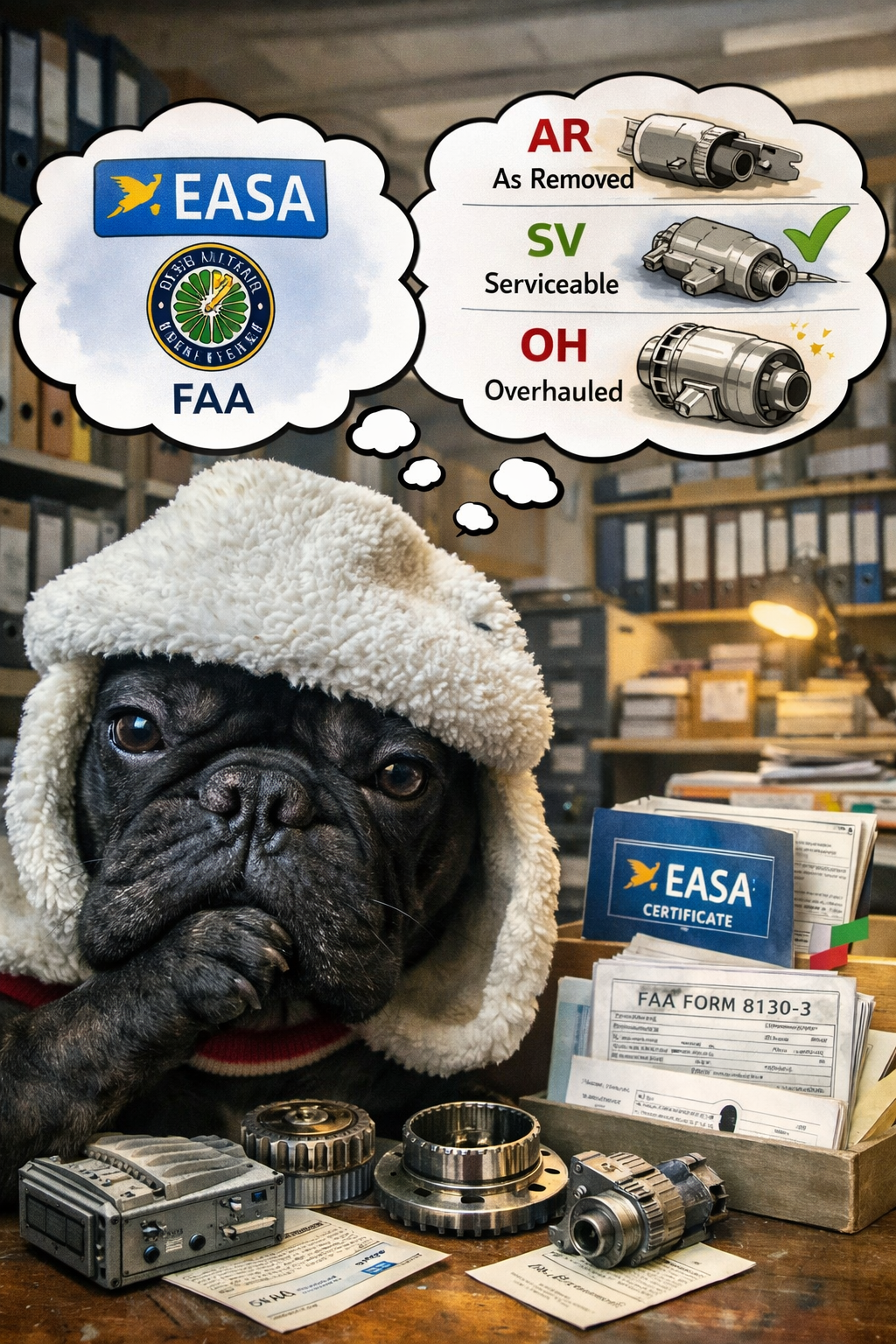

In practice, certification must be interpreted together with removal context, storage history, and condition. A valid release does not override physical deterioration, improper handling, or undocumented exposure. For this reason, certification is evaluated as part of a broader assessment rather than in isolation.

Condition statements and their meaning
Condition statements such as AR (As Removed), SV (Serviceable), US (Unserviceable), OH (Overhauled), RP (Repaired), NS (New Surplus), and NEW (Factory New) are frequently misunderstood. These terms describe status at a specific point in time and under specific conditions.

“As Removed” indicates removal status, not usability. “Serviceable” reflects condition at release, not future performance. “Overhauled” and “Repaired” depend entirely on scope and approved data. In practice, condition statements must always be read together with documentation, removal context, and technical judgement.

At NEDAVION, condition statements are applied conservatively and consistently. Where uncertainty exists, it is disclosed rather than masked by optimistic terminology.

Storage, handling, and preservation
Documentation and condition are directly affected by how a part is handled after removal. Improper storage, exposure to moisture, contamination, or mechanical damage can invalidate otherwise acceptable documentation. Preservation is therefore an operational factor, not a logistical afterthought.

In practice, traceability that is not supported by proper handling and storage loses value rapidly. For major assemblies and controlled components, preservation standards are as important as paperwork.

Documentation gaps and conservative treatment
Documentation gaps are common, particularly for older aircraft, distressed assets, or material that has passed through multiple ownership transitions. These gaps do not automatically eliminate value, but they must be treated conservatively.

Where documentation is incomplete, assumptions are not used to bridge gaps. Instead, limitations are stated clearly and the component is positioned according to what can be supported defensibly. This approach reduces downstream disputes and protects transaction integrity.

Why documentation quality matters
The quality of documentation and traceability directly affects:

• acceptance by operators and CAMOs
• repair and overhaul feasibility
• resale and remarketing potential
• regulatory defensibility
• overall asset value

No amount of commercial pressure can compensate for weak documentation. Once integrity is compromised, value cannot be restored through paperwork alone.

Operational position
At NEDAVION, aircraft parts documentation, traceability, and condition are assessed as an integrated whole. Material is represented based on what can be supported in practice, not on theoretical eligibility. This disciplined approach ensures that components entering the market are positioned realistically, accepted predictably, and executed without unnecessary risk.

In real aviation operations, documentation is not a formality — it is the difference between assumption and certainty.

👉 Submit Aircraft for Purchase!